Showing posts with label Gardening. Show all posts

Wednesday, May 16, 2012

Vegetables are in!

We have had such a fabulous spring here in Colorado which has made waiting to plant really hard! But, it was still getting down into the 30's at night so this paranoid gardener just couldn't chance it! After a cold stretch last weekend, the extended forecast called for highs in the 80's and lows in the 50's so I decided it was finally time!
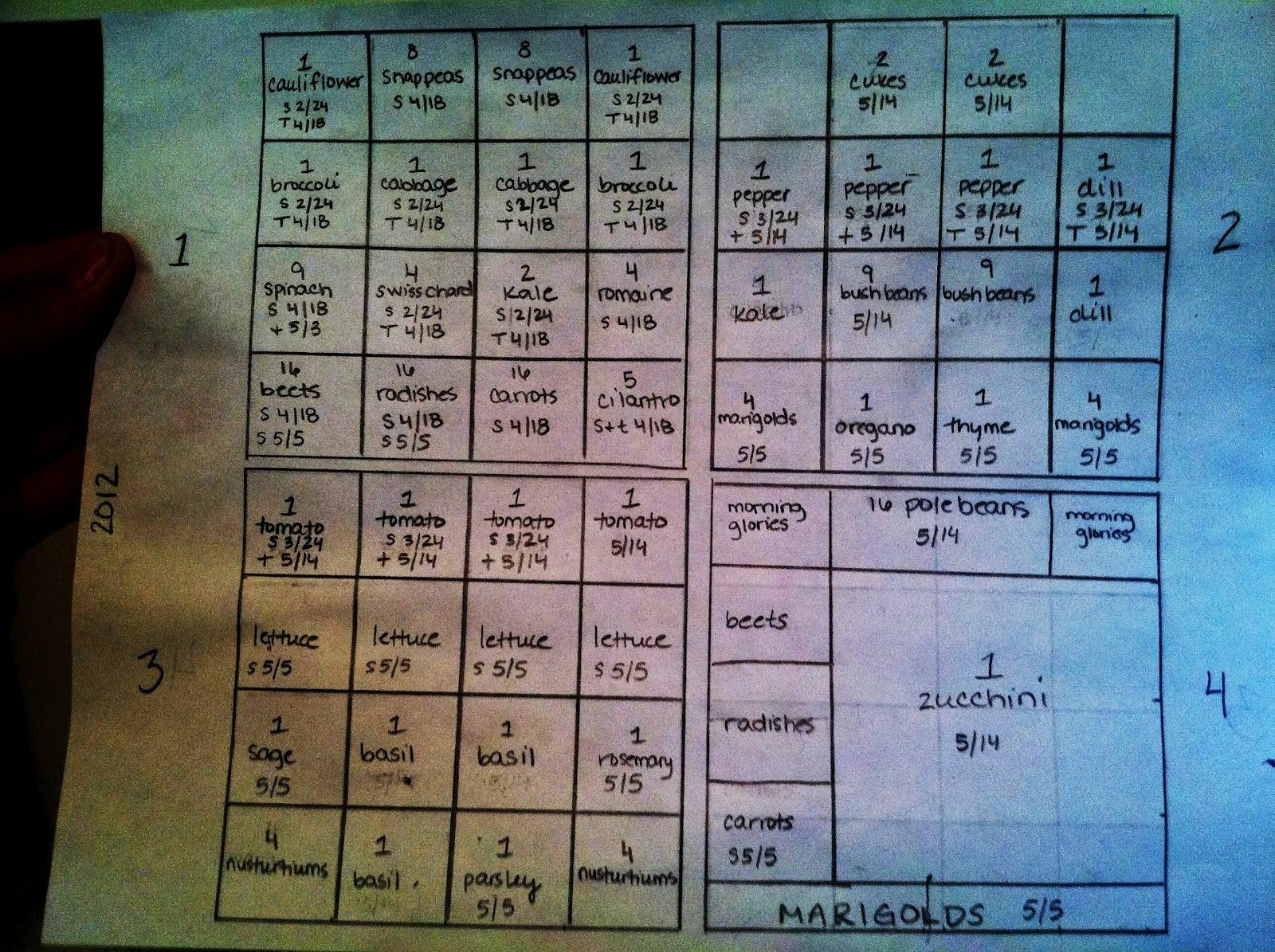

This is my final plan for my 4 beds. It took many rough drafts to get it right, but I think I finally got it! I also wrote down the dates I planted to help me keep track. For the plants that I started from seed indoors, I marked an s (seed)  underneath with the date planted, and a t (transplant) with the date they were transplanted into the garden. On the back of this page I drew up a blank square foot diagram so that as I harvest and plant new things up until frost, I can have an ongoing record.


I soaked my bean, cucumber, zucchini, and nasturtium seeds to help facilitate germination. The beans, cukes and zucchini I only soaked for a couple hours but the nasturtium said to soak for 12-24. 


 This is my cool season bed planted 4/18.


Not even a month later! It is fun to see how much stuff grows. Pictures are a great way to document! Last year, our spring was so horrible that nothing grew at all in the first month!


This bed has cucumber seeds in the back, peppers in the second row, bush beans in the square with 9 white circles (I will plant 9 more in the square next to it in a few weeks) plus marigolds, dill, oregano and thyme, oh, and a pair of safety glasses in the top left hand square that I keep watering and nothing seems to happen??? :)


This bed has tomatoes in the back (I had to buy one big store bought one in hopes of getting some tomatoes a little earlier!) The next row contains a bunch of little lettuce seedlings, then I've got rosemary, basil, sage, parsley and nasturtiums.


This one will have pole beans growing up the back, carrots, beets and radishes growing along the left side, marigolds in the front, but most of the space will be taken up by zucchini. One little seed will grow into a ginormous plant that will produce more zucchini then you will know what to do with!!! Oh wait, yes I do...zucchini fritters, zucchini pancakes, zucchini soup, zucchini brownies, zucchini milk...ideas are endless. Don't worry, I will post all my favorite garden recipes when harvest time begins!

Happy Gardening!!!

Wednesday, April 18, 2012

Time to Plant!!!!

I have been anxiously awaiting this day for weeks now! After a very time consuming and laborious weekend of sifting my soil, I finally came to the realization that the shortcut I took last year by buying garden soil in bulk did not pay off at all!!! After all that sifting, I still had soil that was full of clay and turned into a lake of sludge when watered. So, in the end, I went and bought bagged stuff and started over...lesson learned: do it right the first time!!!! But what to my wondrous eyes should appear, but prepackaged square foot gardening mix, yippee!!! Mel Bartholomew(the creator of square foot gardening) recommends a soil mix of 1/3 vermiculite, 1/3 peat moss and 1/3 compost which is costly and annoying to mix for 4 beds...hence the reason I bought soil in bulk. But now they come in handy, dandy premixed bags, 2 cubic feet in size and costing $12.99. I'll take it!


So soil is ready (in one bed...got 3 more to go!) I soaked it really good so that it is nice and moist for planting (and the water just seeped right in like it was supposed to, big sigh of relief!) I soaked 8 snap pea beans in lukewarm water overnight to help jump start the germination process. I made my square foot grid by tying twine to nails drilled in at one foot intervals. So now it is time to begin. My little seedlings are dying to get our of their cubicles and spread their roots!

First I made my grids of where I would be planting. I planted broccoli, cabbage and cauliflower in the single holes, spinach seeds in the square with 9 boxes. Chard, kale, lettuce and cilantro went into the 4 box squares, and carrots radishes and beet seeds went into the squares with 16 boxes. Snap peas went in a row at the top of the bed and will need a trellis to support them.

Where I planted my seedlings, I made depressions around them so water would easily absorb around the roots. Where I planted seeds, I made a 1 inch depression, filled it halfway with vermiculite, dropped in my seed and then topped it off with vermiculite. Then I lightly watered the seedlings and misted the seeds. I also planted late afternoon when the sun wasn't as hot because that can be a shock to new transplants. It is very important to keep the soil moist at all times so the new transplants don't dry out and the seeds can germinate.

Tuesday, March 27, 2012

Getting the garden ready

It is almost time to plant cool season veggies, which, depending on the variety, can be planted anywhere from 4-8 weeks before the last spring frost. This varies from state to state so check your area before deciding when to plant. Our last frost is at the end of May, so I am going to start planting most of my veggies Easter weekend. In the meantime, I want to prep my soil and prepare any structures beforehand.

My soil seemed a little too rocky and sticky to my taste so my husband built me a soil sifter by screwing 4 2x6's together to make a square, attaching some screen to the bottom and then attaching some legs so that it will sit about a foot off the ground. It is a bit time consuming but after sifting my soil, I removed tons of rocks and sticks and was left with the fluffiest soil that roots and root vegetables will love! Be sure to throw back in any worms you sift out since those are your gardens best friends! I amended my soil in the fall with compost and vermiculite but I might throw one more bag in. I like to mix up my compost sources to get a variety of nutrients. I have plans to build my own compost pile, I just need to wait for my husband to find the time to build it since he is currently working 2 jobs and renovating our family room. Maybe this fall...


My cauliflower, broccoli, cabbage, kale and chard seeds are growing pretty big. I started hardening them off this week by placing them outside in the sun for a couple hours each day. They need to gradually spend more time outside each day, and even a few nights outside (covered) before I plant them in the garden to prepare them for the outside elements. I also planted my tomatoes, peppers and some herbs from seed, but those won't go into the garden until the end of May. This weekend I will build a support structure for my snap peas so I will post more about that later.  


This is my plan for my first 4'x4' square. Cauliflower, broccoli and cabbage can be planted one per square foot, spinach can be planted 9 per square foot, chard, kale lettuce and cilantro is planted 4 per square foot, and carrots, beets and radishes planted 16 per square foot. Carrots, beets, radish and lettuce can all be continually planted throughout the growing season (every 2-3 weeks) for continual harvest. Lettuce does not do as well in the hottest months but can be grown if given some shade. And as soon as my broccoli, cabbage, cauliflower and spinach are harvested, I can use those squares to plant warm season veggies. Also pay attention to how big your plants will get. You want to keep the biggest veggies towards the back of the box facing N or E and keep the shortest ones in the front facing W or S.


Saturday, February 25, 2012

Starting Seeds


So I had this brilliant idea that my two year old and I would have a lovely afternoon planting seeds. What a test in patience! I think for this year he will be much better at watching them grow and picking the finished product!  I have been growing warm season veggies (tomatoes, peppers, cukes, beans and herbs) for over 6 years now, but after starting the square foot gardening method (more on that later) I am venturing into cool season veggies! Most of the seeds (carrots, radishes, beets, snap peas, lettuce, spinach) can be sown right into the garden  a month or so before the last spring frost, but some, particularly veggies in the cabbage family, need to be started now and then transplanted into the garden later. I have never started my own seeds indoors and I think I am opening a door into a wonderful new aspect of gardening!!! Now I won't be at the mercy of the nurseries not so great variety of GMO plants. Which opens another door into yet another fabulous world of gardening...heirloom seeds! Most of the plants grown these days are genetically modified but heirloom seeds are ancient seeds from around the world that have earned their success through natural selection. And the variety is out of this world!!! Yellow and white cucumbers, pink, white, and purple radishes, striped beets, yellow and red carrots, purple cauliflower, more varieties of tomatoes than you can imagine, and, well, you get the picture!  So yesterday I planted 3 cabbage, 3 broccoli, 3 cauliflower, 4 kale and 4 rainbow chard, and now the adventure begins! Over the growing season, I will break down gardening in a way that will make even the most hesitant and skeptical person excited to garden! It truly is quite easy, especially with the square foot method, and probably ranks as one of the most rewarding, and satisfying hobbies to take up.
I will be starting my tomatoes and peppers by seed when I get back from Florida around March 20th, so if anyone is interested in joining me, here is what you will need:
1. a seed growing kit like the one above with drainage tray, individual cells, and a cover
2. good potting soil
3. labels (I used popsicle sticks)
4. your seeds (I ordered mine online from www.rareseeds.com)
5. a grow light. They are pretty pricey but it is a one time investment. If you are confident that you have a really sunny spot in your house, you can always start that way and invest in one down the road if you are not successful. 
6. And if you are getting in to gardening, you just might as well order Mel Bartholomew's Square Foot gardening book because it is pretty much the best gardening resource you will own.
7. And don't forget you need a spot to grow them!!! As you will learn from the square foot method, all you need is a 4ftx4ft square, preferably raised, in a really sunny spot. If you are new to gardening, I would just start with one. You can always add more squares down the road as you become more experienced (and if you have the room)
This is my garden from last year. I currently have four 4x4 squares and am planning to add 4 more so that I can get into growing cutting flowers too. But one 4x4 square will have 16 square feet which means you can grow 16 varieties of vegetables, so it will easily keep a family of 4 in salad veggies for the season.

HAPPY GARDENING!!!